Exploring The City
Spend your days walking around this magical city
Oaxaca's historic centre is compact, walkable, and endlessly rewarding. Its streets are lined with colonial architecture, vivid street art, ancient churches, world-class museums, and the kind of neighbourhood life that makes you want to slow down and stay longer. The best way to experience it is simply to walk but below is our guide to the places and moments we love most, to help you make the most of every hour.

Places To Visit

TEMPLO DE SANTO DOMINGO DE GUZMÁN
The most magnificent church in Oaxaca, and one of the most spectacular in all of Mexico. Built by Dominican friars from 1575, its baroque facade and gold-leaf interior are breathtaking. Visit in the late afternoon when the golden light is at its best, and linger in the square outside, it is one of the great gathering places in the city.

THE ZÓCALO
The heart of the city. The main square is where Oaxacan life gathers, for coffee in the morning, for people-watching in the afternoon, for live music and dancing as the evening settles in. On Wednesday nights, local couples gather to dance the danzón to live music, one of the most quietly beautiful things you will see in the city. Sit, order something, and watch the world go by.

CALLE MACEDONIO ALCALÁ
The pedestrian street connecting Santo Domingo to the Zócalo is the main artery of the city's cultural life. Lined with galleries, craft shops, mezcalerías, restaurants, and cafés housed in centuries-old colonial buildings, it is best explored slowly and on foot. This is the street where Oaxaca shows off.

JARDÍN ETNOBOTÁNICO
Next door to the Templo Santo Domingo is Oaxaca's ethnobotanical garden, containing a beautiful collection of plants from all over the state. Oaxaca is the most biodiverse state in Mexico and the plants are grouped according to ecological region. Entry is by guided tour only. You can not book ahead, you need to view the schedule for the tours daily. Normally in the morning with one tour at 5pm.

MUSEO DE LAS CULTURAS DE OAXACA
Set within the former monastery attached to Santo Domingo, this excellent museum takes you through Oaxacan history from pre-Hispanic times to the present. The building alone, its cloistered courtyards and sweeping views over the Ethnobotanical Garden, is worth the visit.

BARRIO JALATLACO
A ten-minute walk from the centre, Jalatlaco is one of the oldest and most beautiful neighbourhoods in the city, cobblestone streets, brightly painted houses, and a quieter, more residential atmosphere that offers a welcome contrast to the bustle of the centre. Wander it in the morning with a coffee.
The Markets

Mercado Benito Juárez
- Open Daily
Just south of the Zócalo
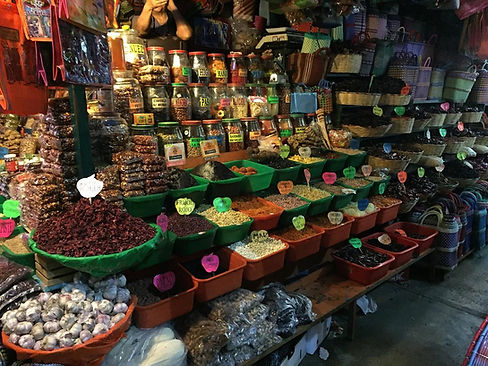
One of the oldest trading centres in Oaxaca City, opened in 1894, Mercado Benito Juárez is housed in a structure that recalls an old railway station - iron roof, iron doors - keeping centuries of tradition on the inside. Of the two markets that sit side by side south of the Zócalo, this is the one for shopping - a sprawling, vibrant mix of food, craft, clothing, and regional goods that gives you the fullest possible picture of what Oaxaca produces and sells.
This is the best single market in the city for taking something genuinely Oaxacan home. You will find traditional Oaxacan garments, embroidered blouses and dresses, handcrafted leather goods and huarache sandals, woven textiles, pottery, ceramics, and alebrijes alongside regional food products like mole paste, dried chiles, Oaxacan chocolate, coffee, and mezcal.
For a wider and more curated selection of crafts and artisan goods - particularly black pottery, higher quality textiles, and alebrijes - the Mercado de Artesanías is just a couple of blocks away and well worth combining into the same morning.
Mercado 20 de Noviembre
- Open Daily
Directly beside Mercado Benito Juárez
If Benito Juárez is the market for shopping, 20 de Noviembre is the market for eating. The two sit side by side and are best visited together - but it is important to know that 20 de Noviembre is almost entirely dedicated to prepared food.
It is full of small restaurants and vendors where you sit down and eat - this is not the place to shop for crafts or clothing, but it is absolutely the place to have one of the most memorable meals of your trip. It is louder, smokier, and more visceral than its neighbour, and completely unmissable.
Inside the market, the Pasillo de Humo - Smoke Alley - is a corridor of vendors selling meats and vegetables that you choose yourself, then have grilled to order over charcoal. From side to side, stalls display the cuts that define Oaxacan barbecue - tasajo (air-dried beef sliced paper thin), cecina enchilada (spiced cured pork), and tripa(tripe) - all grilled over open flame in a haze of wood smoke while you watch. It is one of the most atmospheric and memorable eating experiences in the city. Order whatever looks and smells best, take a seat, and eat.
Beyond the Pasillo de Humo, the market is lined with traditional comedores - small family-run eating spots, many of whom have occupied the same stall for generations - serving tlayudas, mole, memelas, enmoladas, and soups. This is also a favourite spot for breakfast - pan de yema, Oaxacan hot chocolate, and chilaquiles made with the giant white-corn tortillas the region is famous for.

Mercado de Artesanías
Five blocks southwest of the Zócalo
The largest market in the city dedicated exclusively to crafts - one of the finest craft markets in the country - with a wide selection and fair prices. Where Benito Juárez and 20 de Noviembre are markets for food, this one is entirely devoted to what Oaxaca makes with its hands. If you are looking to take something genuinely beautiful and locally made home with you, this is where to start.
Unlike the tourist shops along the Andador or the stalls at Benito Juárez, the Mercado de Artesanías sells fair-trade goods made by local and indigenous artisans from across the state. Wandering through, you will find vibrant handwoven rugs and textiles, intricately embroidered clothing and blouses, traditional pottery in the three distinctive Oaxacan clays - barro negro, barro verde, and barro rojo - and alebrijes in every size and level of intricacy. There are also leather goods, jewellery, baskets, carved wooden figures, regional clothing, and a range of smaller items that make for meaningful and carefully made gifts.
This is important to know: like much of Oaxaca's artisan and boutique culture, the Mercado de Artesanías comes fully alive in the afternoon. Many stalls open late morning and trade through the afternoon into the early evening.
Open daily. Calle Ignacio Zaragoza at Calle J.P. García, Centro. Best visited in the afternoon.
TLACOLULA MARKET
- Sundays ONLY
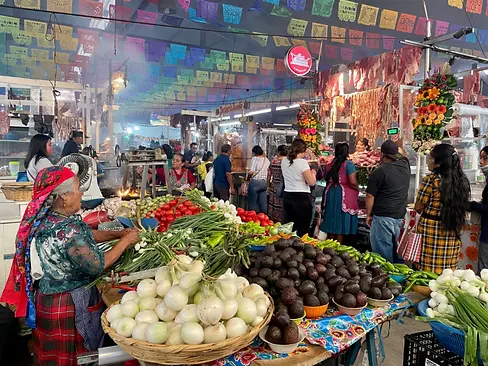
Forty-five minutes east of the city along the road toward Mitla, the town of Tlacolula de Matamoros transforms every Sunday into one of the most extraordinary market experiences in all of Mexico. One of the oldest markets in Oaxaca, dating back to pre-Hispanic times, Tlacolula has been a gathering place for centuries - where indigenous communities from across the region come to trade, sell, and connect. On any other day of the week it is an unremarkable town. On Sundays, the streets are closed to traffic and thousands of vendors and shoppers arrive from surrounding villages - many in traditional dress, many speaking Zapotec - and the whole place comes alive in a way that has changed remarkably little over the centuries.
What makes Tlacolula special is precisely that it is not tourist-minded. The market is vast and organised by category - fresh produce, meats, cheeses, baked goods, textiles, crafts, mezcal, household goods, tools - and the overall experience is, as one regular puts it, beautiful chaos. You will see villagers dressed in colourful indigenous clothing, vendors selling fresh produce, traditional foods, and handmade goods. The overall experience is chaotic in the best way and a real treat for the senses.
Tlacolula sits conveniently on the same road as the Tule Tree and the ruins of Mitla, making it an ideal anchor for a full Eastern Valleys Sunday. Arrive early - by mid-morning the crowds build considerably.
Private drivers or guided market experiences can be arranged.